

Module B
"Fake news" and the Infodemic
Module Objectives
By the end of this module, the student will be able to…
- explain the problem with the use of the term “fake news”
- compare and contrast misinformation and disinformation
- illustrate how networked disinformation operates in the country
- investigate the seven most common types of mis-/disinformation
DepEd MELCs for MIL
- Discuss the implication of media and information to an individual and the society
- Analyze how the different dimensions are formally and informally produced, organized, and disseminated
What makes misinformation and disinformation better terms to use than “fake news”?
HEADS UP! Think of 3 common reasons why someone intends to spread “fake news”. Example: Someone wants to destroy another person’s reputation.
There’s a reason why we have been using the term “fake news” inside quotation marks. It’s because in spite of the popular use of the term, experts actually recommend the public NOT to use it. They argue that “if it’s fake, it’s not news” which means the words “fake” and “news” are not supposed to go together. Moreover, people’s understanding and use of the term has become vague and varied through time. “Fake news” has been used to label many different kinds of content from simple lies to rumors to outdated information to propaganda.
Some “fake news” are not completely ‘fake’; some are just misleading while some are genuine but used out of context. Also, most content that is deceptive in some way are not made to look like news at all (e.g. memes, tweets, videos, etc). To add to these, the term “fake news” has been weaponized; it has become a term used by politicians and other groups to attack and question the credibility of many professional news media around the world.
So, to avoid the confusion that comes with the use of the term “fake news”, we recommend using the terms Misinformation and Disinformation. Collectively, Dr. Claire Wardle, co-founder and leader of First Draft, refers to these as the Information Disorder — “the many ways our information environment is polluted.”
Disinformation vs Misinformation
You may have heard these terms used interchangeably to talk about the issue of the infodemic. However, it is important to be able to distinguish them to understand how they are created and how they spread differently.
So, how does disinformation and misinformation differ? Just one thing: INTENT TO HARM. While misinformation and disinformation have more or less the same harmful effects, they are spread NOT for the same reasons. People who spread misinformation are those who are just misinformed; they have no intention to deceive or do harm to others. This makes them slightly less guilty compared to those who spread false or misleading information with clear intent to harm (i.e. disinformation).
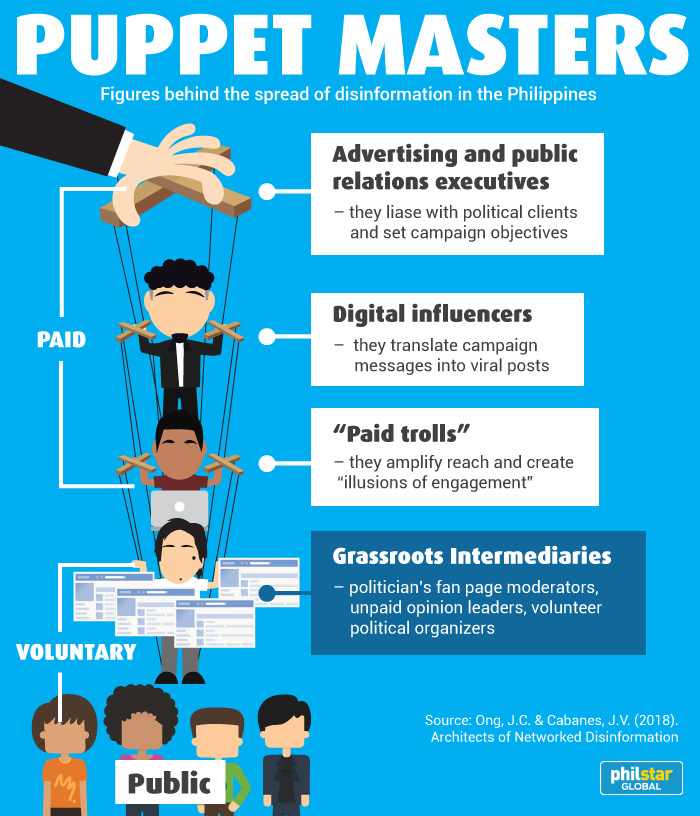
Moreover, it is important to note that, unlike misinformation, disinformation operates in an orchestrated manner; meaning, there are organized, coordinated, and well-funded systems that run it. Political disinformation, to be exact, is run by professionals. It is a vast network that connects fake account operators to digital influencers all the way to the chief architects in the advertising and PR (public relations) industries. This shows that disinformation is a much more complex and grave problem than misinformation (i.e. making an honest mistake of sharing false information). Putting them both under the umbrella term “fake news” blurs this distinction, and does not help us in crafting the right solutions to our problems.
TWEET YOUR THOUGHTS. In the simplest way you can, as if you are talking to an 8-year-old, explain why using the terms mis-/disinformation is better than “fake news”. Tweet us at @ootbmedialit and use the hashtag #IWASFAKE.
FOR THE NEXT LESSON, you will zoom in further on misinformation and disinformation and learn about the seven (7) types of content commonly found in the infodemic.
What are the seven types of mis-/disinformation?
HEADS UP! Think of 3 of the most important qualities of effective mis-/disinformation. Example: It must be very well edited.
Within the two (2) main categories of the Information Disorder (Misinformation and Disinformation), you will commonly find seven (7) specific types of content according to First Draft. This will help you understand the complexity of the online information environment. This will also show you that there is a wide spectrum that exists between what is true and what is false, between “fake” and “not fake”.
The 7 Types of Mis-/Disinformation
Satire
Satire is a literary technique that employs humor, irony, or exaggeration to expose flaws and criticize individuals, governments, or society itself. Although satirical pieces are meant to be humorous, its greater purpose is often constructive social criticism. The problem is when satire is used to strategically spread rumors and conspiracies. When challenged, it can be simply shrugged off “as a joke”, something not meant to be taken seriously. Furthermore, satire can also be dangerous when from its original source, it gets spread online and turned into screenshots or memes, losing its original context in the process.False connection
Clickbaits are the best examples of the use of ‘false connection’ — sensational language or imagery used to drive “clicks”. This is when you encounter a headline or an image designed to capture your attention, but when you click through it, the link leads you to a content that is of no value to you or content that sells you an item or service. We can’t expect media organizations to stop using clickbait techniques, after all, they need clicks. Our task as readers is to be wary of them as they often trigger our emotion only to drive traffic on their websites.Misleading content
What counts as ‘misleading’ can be varied and hard to define, but it usually involves omitting pieces of information to tell a story in a certain way (i.e. cropping photos to change its message, choosing statistics selectively). This is also called ‘framing‘. Even the most advanced technology cannot easily detect misleading use of information because it involves contextualization and nuance. Meaning, it requires our brains to analyze the whole story or the bigger picture to judge whether a content intentionally misleads or not.Imposter content
We always like to employ mental shortcuts to help us understand information. One very powerful shortcut is seeing a brand or person we already know and trust. When we get information coming from trusted brands or people, we are not as doubtful. But the problem is, it is very easy to make fake accounts and pretend to be someone else online. Imposter content is false or misleading content that claims to be from established brands, organizations, or personalities.False context
When genuine information is shared out of its original context such as when old news stories are re-shared in present time, it can be very dangerous. Sharing information in its proper context is very important because the context (i.e. the time, place, situation) within which an event or news story existed helps explain the event. Sometimes, it is only a plain case of misinformation where a person mistakenly re-shares an old story. Other times, the purpose is more deliberate: to mislead the people by sharing information in a different context.Manipulated content
Manipulated content is genuine content that is altered or edited to change the message. It is not completely made-up or fabricated. Many people fall for this kind of manipulation because most of us only glance on images or captions while scrolling down our phones. As long as it fits a story and is good enough to ‘look real’, people may share it.Fabricated content
Fabricated content is anything that is 100% false. This is the only type of content that we can really consider as purely ‘fake’. Staged videos, made-up quotes, and fake websites fall under this category. ‘Deepfakes’ or ‘synthetic media’ are fabricated media produced using Artificial Intelligence (AI), which usually combine different elements of video and audio to create ‘new’ content that never actually happened.
Since these seven (7) types exist in a spectrum, more than one type can apply to a specific piece of content. For example, a clickbait article that employs false connection may also be considered fabricated content if it is 100% false. Moreover, if it is created and uploaded by a fake account of an established brand, then you can also call it an imposter content.
TWEET YOUR THOUGHTS. Is there a way to prevent satirical content from being harmful? How? Tweet us at @ootbmedialit and use the hashtag #IWASFAKE.
THAT ENDS MODULE B. Are you ready to test your knowledge and practice your skills? Head on the the Pop Quiz in the next tab and ask us or your teacher for Module B worksheets.
* * *
FOR THE NEXT LESSON, you will dive deep into the four steps you must take to avoid and protect yourself from “fake news”. We call it IWAS FAKE.
Module A Pop Quiz
#IWASFAKE Playlist 3: What is “Fake News” and How Does it Work?



© This learning resource is made available by Out of The Box Media Literacy Initiative under a Creative Commons Attribution-NonCommercial 4.0 International license (CC BY-NC 4.0). You can copy and redistribute the material, remix, transform or build upon it so long as you attribute Out of The Box Media Literacy Initiative as the original source. You may not use the material for commercial purposes. View detailed license information at creativecommons.org.